dBm/dBW Calculator

Remember to press the ENTER key after you type in a value.

New! Why are you using this calculator? Learn to convert FROM dBm to milliwatts in your head! Read our free online tutorial complete with interactive practice examples.

New Course: How to Speak RF (and Wireless) teaches everything you need to know about the wireless world without complicated math!

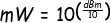
"dBm" notation represents a measured power level in decibels relative to 1mW. "dBW" notation represents a power level in decibels relative to 1 Watt. In other words, "how much stronger/weaker is this signal than 1mW?" If a signal has a power level of 3dBm, that means it is 2 times as strong as 1mW, so the signal power level is 2mW.

"dB" notation is useful for representing gain or attenuation, where the output will always be related to the level of the input signal. The input signal is either amplified or diminsihed by a certain ratio, which is represented in decibels.

"dBm" and "dBW" notation is useful for representing a measured signal power level, such as the power level at the input to an amplifier.

"dBV" shows the ratio of the voltage relative to one Volt. Note that in order to calculate power values from voltages and vice versa, you need to know the impedance of the system, so this applet assumes you are using a 50 ohm system.

Using dB notation simplifies power calculations in communications systems. For example, if the measured power at the input of an amplifier is 5dBm and the gain of the amplifier is 20dB, then the measured output power after the amplifier should be 5dBm + 20dB = 25dBm.

Also try the decibel conversion applet.


If you interested in wireless networks, have a look at Besser Associates' courses on IEEE802.11 and Bluetooth.

To learn more about decibel conversion, take Besser Associates RF and Wireless Made Simple course.

Decibel conversion is also reviewed in Besser Associates circuit design course, Applied RF Techniques I.

Check back here at BesserNet.com for more articles, tutorials, and applets that will help you better understand decibel conversion.

See also: Decibel and dBm articles on WikiPedia.

Give us your feedback about this applet.


Webinars & Applets :

Quick Links:

Besser Associates